In keeping with the mantra ‘You can’t manage what you can’t measure’, understanding the relationship between wildlife strike rates and seasonality in your area can improve the efficiency of your wildlife hazard management techniques.
Having data about the times of the year where strikes are most prevalent in your area, enables you to focus your resources and efforts where they are most needed, for example during fledging, as young birds with no experience of the dangers aircraft pose enter the scene.
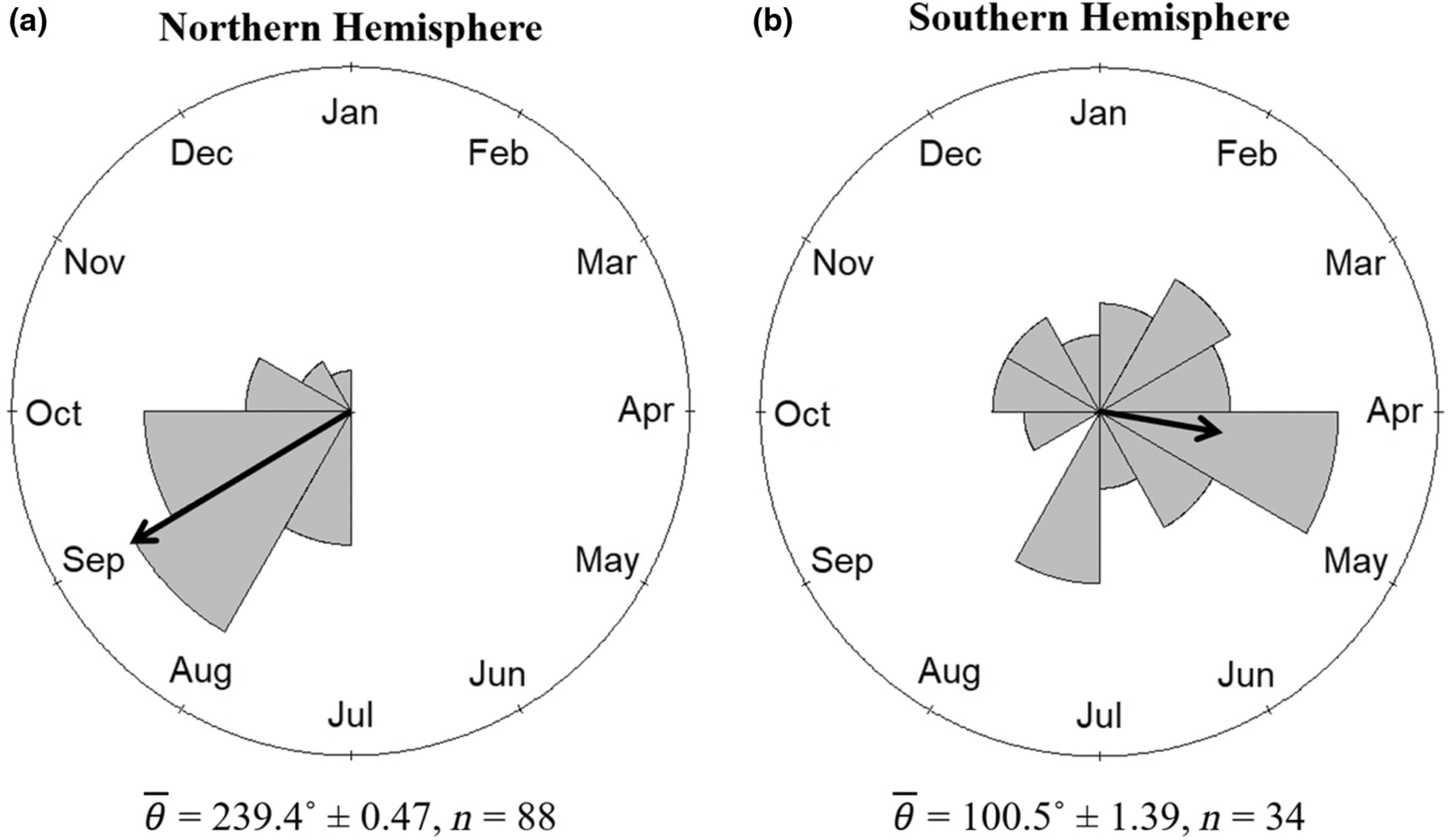
An August 2024 study found that annual peaks in bird strikes occurred between the late summer to autumn. The northern hemisphere peaked distinctly in August–September and had greater seasonality, whereas the southern hemisphere peaked in April with more distributed strikes across the year. The study, ‘Biogeographical patterns in the seasonality of bird collisions with aircraft’ by researchers Tirth Vaishnav, John Haywood and Kevin C. Burns, of Wellington, New Zealand’s Victoria University, collated monthly bird strike data from 122 airports across the globe. The global dataset for this study complements results from previous studies that reviewed bird strike seasonality at country-level spatial scales.
Figure 1 Rose diagrams illustrating monthly frequencies of bird strikes for airports in the Northern Hemisphere (a) and airports in the Southern Hemisphere (b). Each bin represents 1 month and occupies 30° of the circle in a clockwise manner. Angle of mean vector (black arrow) indicates the time of year with higher strikes on average. Length of vector is inversely proportional to circular standard deviation. Bird strikes in the Northern Hemisphere airports peaked distinctly in August–September and had a lower circular standard deviation than the airports in the Southern Hemisphere, indicating that strikes are more frequent in that period compared to other months. Bird strikes in the Southern Hemisphere peaked in April and had a higher circular standard deviation, meaning that the strikes are more spread out annually.
Figure 2
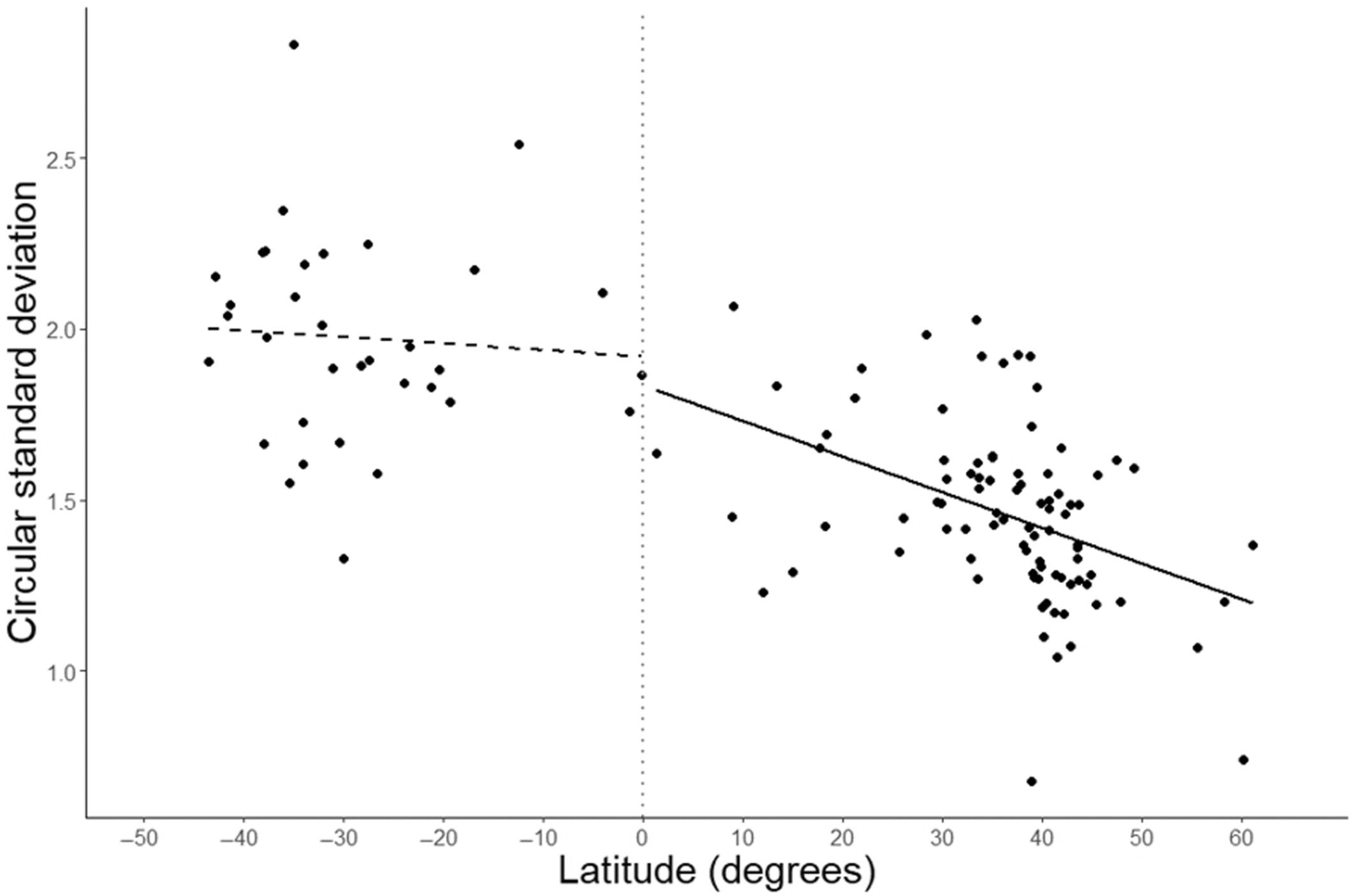
Linear regression analyses of circular standard deviations (annual spread of bird strikes) versus latitude of each airport. Circular standard deviations remain relatively constant in the Southern Hemisphere (black dashed line; R2 = 0.005, p = 0.687, n = 34) but decrease significantly from the equator (grey dotted line) towards the northern latitudes (black solid line; R2 = 0.189, p < 0.001, n = 88). Southern Hemisphere latitudes are shown as negative values.
The study’s northern hemisphere findings are reinforced in the Federal Aviation Administration’s National Wildlife Strike Database Serial Report Number 30, covering the years 1990-2023. Over those years, most bird strikes (54 percent) occurred between July and October, when birds are migrating, and populations are at their annual peak in North America following the nesting season.
Although the study provides a largescale overview of key months for wildlife hazard management, it’s important to understand the seasonality of your specific location. In a (now admittedly dated) report spanning 1991–2001, the Australian Transport Safety Bureau found a disparity between seasonal strike patterns in northern and southern Australia. Whereas the northern strike rates peaked during February, May and October, the southern rates were at their peak during December and January, with a low in June. Moreover, the northern airports strike data showed a higher strike rate, with greater seasonal variation than their southern counterparts.
In addressing the seasonal variations of bird strikes between the two hemispheres, the study highlights that 80 per cent of the southern hemisphere is covered by water. The absorption of heat by the oceans in the southern hemisphere leads to more stable temperatures and lower fluctuations in annual productivity. Consequently, the authors suggest that this may lead to differences in species richness, the absolute number of migratory species, and their proportions. ‘Annual migration schedules tend to be stronger at more northerly latitudes’. Although these rules of thumb are useful for management decisions, increasing weather and climatic variation may scramble historic patterns due to changes such as ‘the increasing frequency of mid- latitude climate extremes’. For this reason, ongoing tracking of seasonal bird strike patterns is an essential component of effective wildlife hazard management programs.