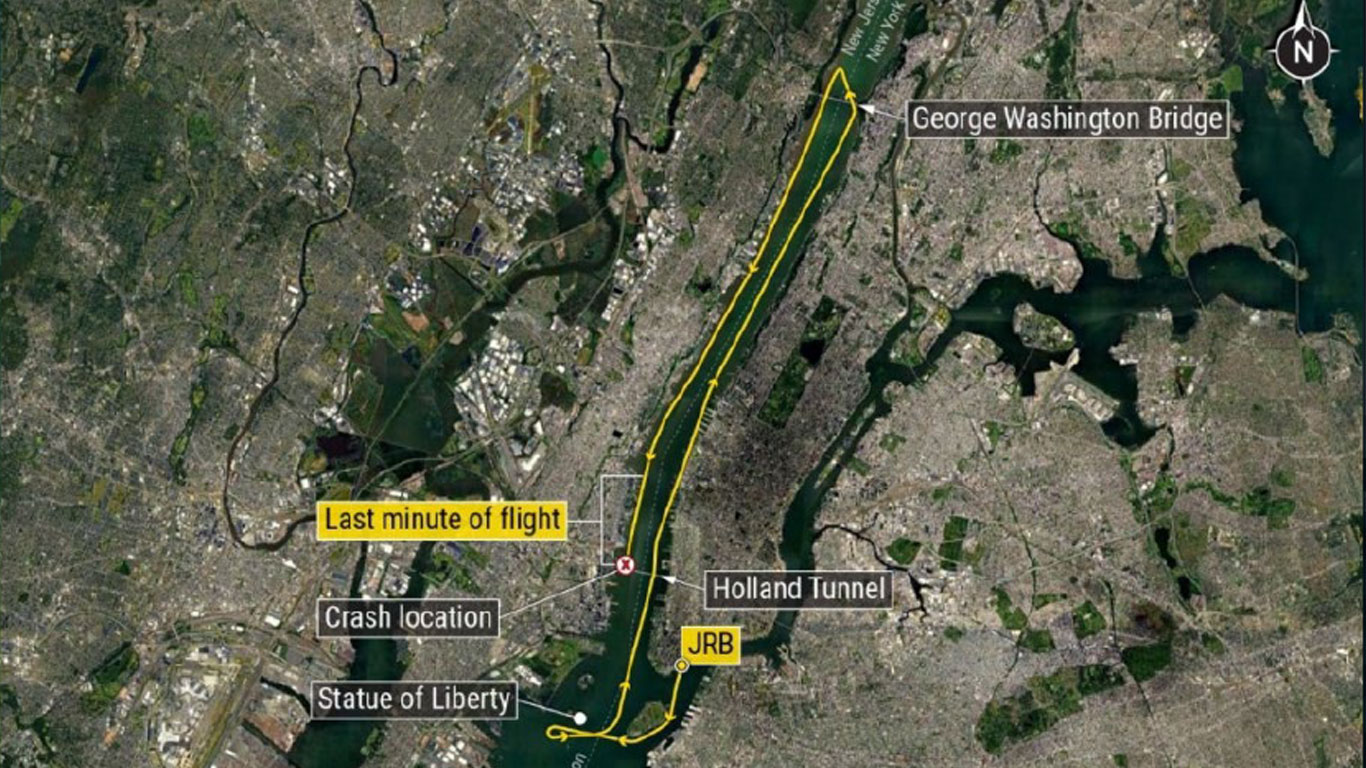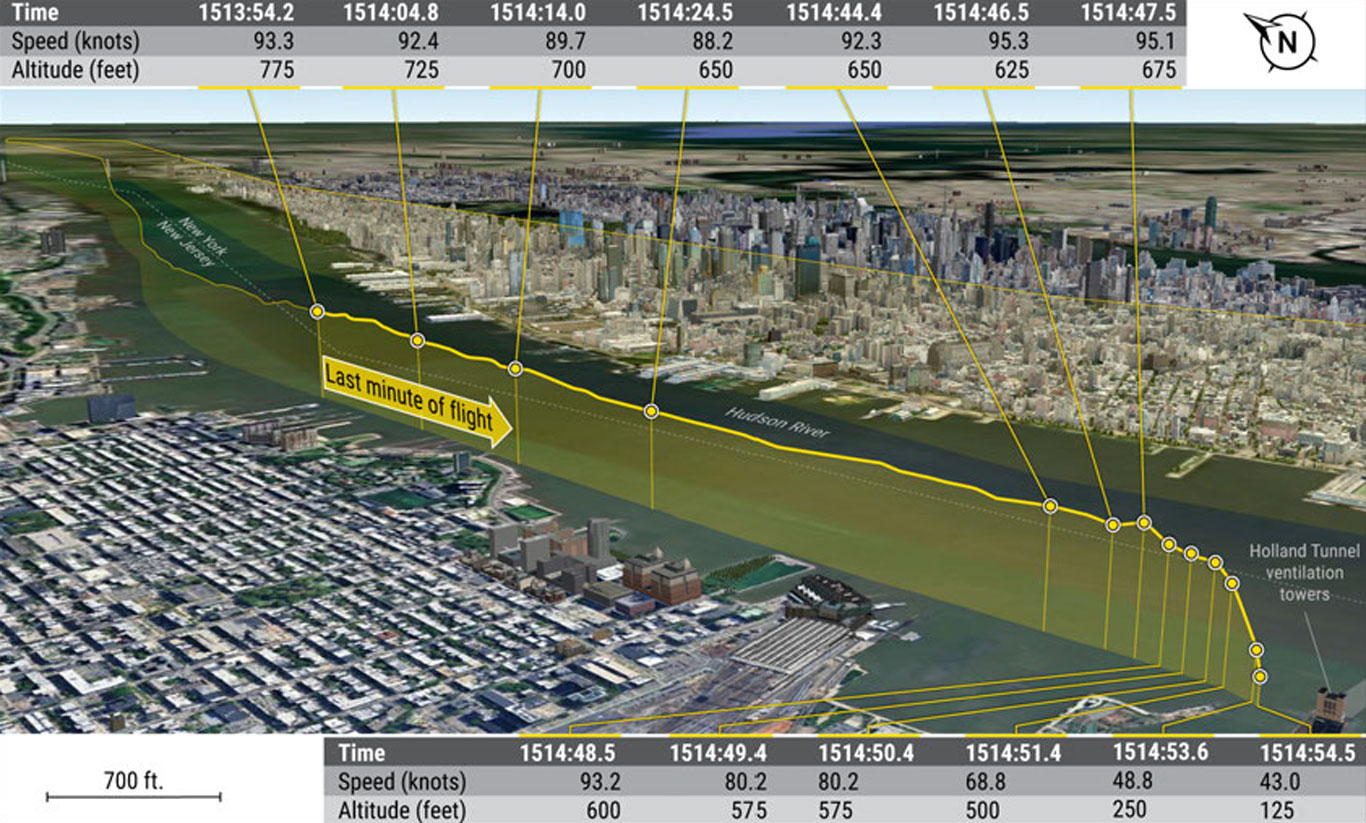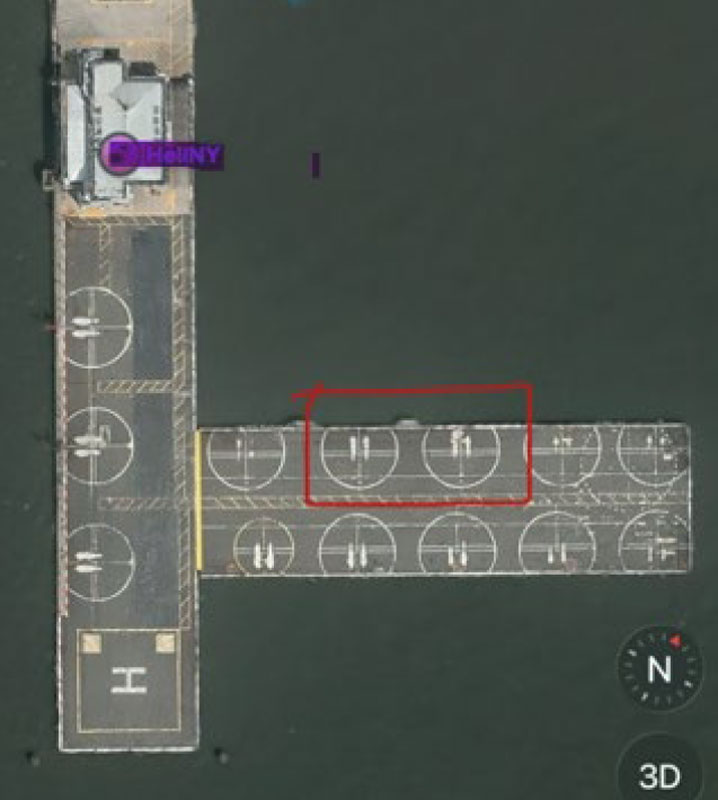
The 25-minute flight would take the visiting Spanish family: Siemens executive Agustin Escobar, his wife, Mercè Camprubí Montal, and their three young children — Augustin, 10, Mercedes, 8, and Victor, 4 — ‘on a flight over to the statue of liberty, north to the George Washington bridge, then a south turn on the west side of the Hudson River southbound where it would land back at the downtown Manhattan heliport. As the helicopter approached the Holland Tunnel ventilation towers near Jersey City, New Jersey, it was flying at between 625 and 650 ft. The helicopter’s altitude then increased rapidly to 675 ft before it entered an uncontrolled descent. The data ended at 1514:54.5.’
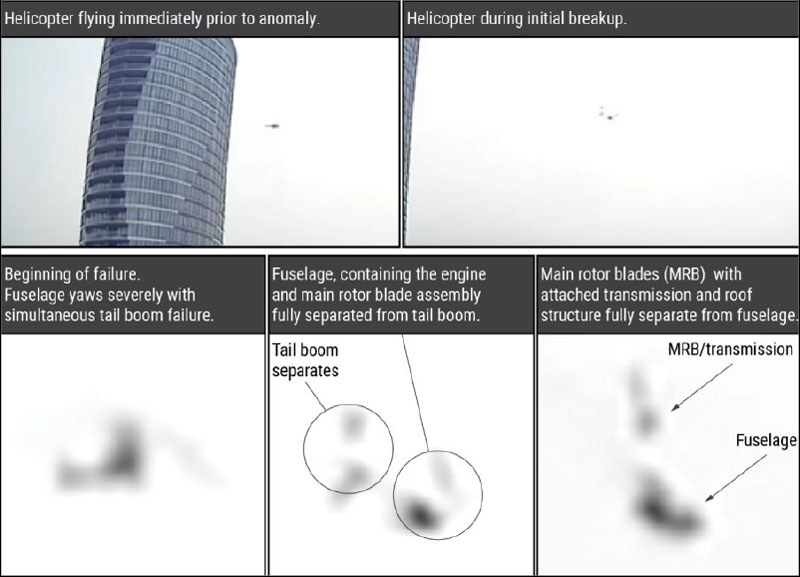
Multiple witnesses described hearing several loud ‘bangs’ and ‘pops’ from the the helicopter before it broke up and descended into the river. Surveillance video (with accompanying audio) captured the helicopter traveling south before it suddenly separated into three major sections: the fuselage (including the engine), the main rotor system (including both main rotor blades, transmission, and roof beam structure), and the tail boom (including the tail rotor).
An additional witness reported that just minutes before the accident, she ran by the Newport lighthouse, and a large flock of geese took flight. ‘The geese were big and there were many of them. When the helicopter went bang, I immediately thought it was a bird strike.’
The helicopter was equipped with the Pulselite® System from Precise Flight, which is an FAA-certified, electrical system modification designed to increase aircraft visibility/ recognition for collision avoidance with other aircraft and reduce bird strikes. It works by pulsing existing landing and auxiliary lights at a specific frequency and pattern, in this case, the landing light for the Bell 206 accident helicopter.
‘During examination of the fuselage and rotor blades, main rotor blade foamcore pieces and a severed bird wing were discovered on the ground and on roof tops about 2,000 feet northwest of the wreckage recovery site. A specialist from the Smithsonian Institution’s Feather Identification Lab (National Museum of Natural History) was invited by the NTSB to conduct sampling of the wreckage to identify potential bird remains. The Feather Identification Lab at the NTSB Materials Laboratory did additional sampling of the main rotor blades, and discovered bird remains.
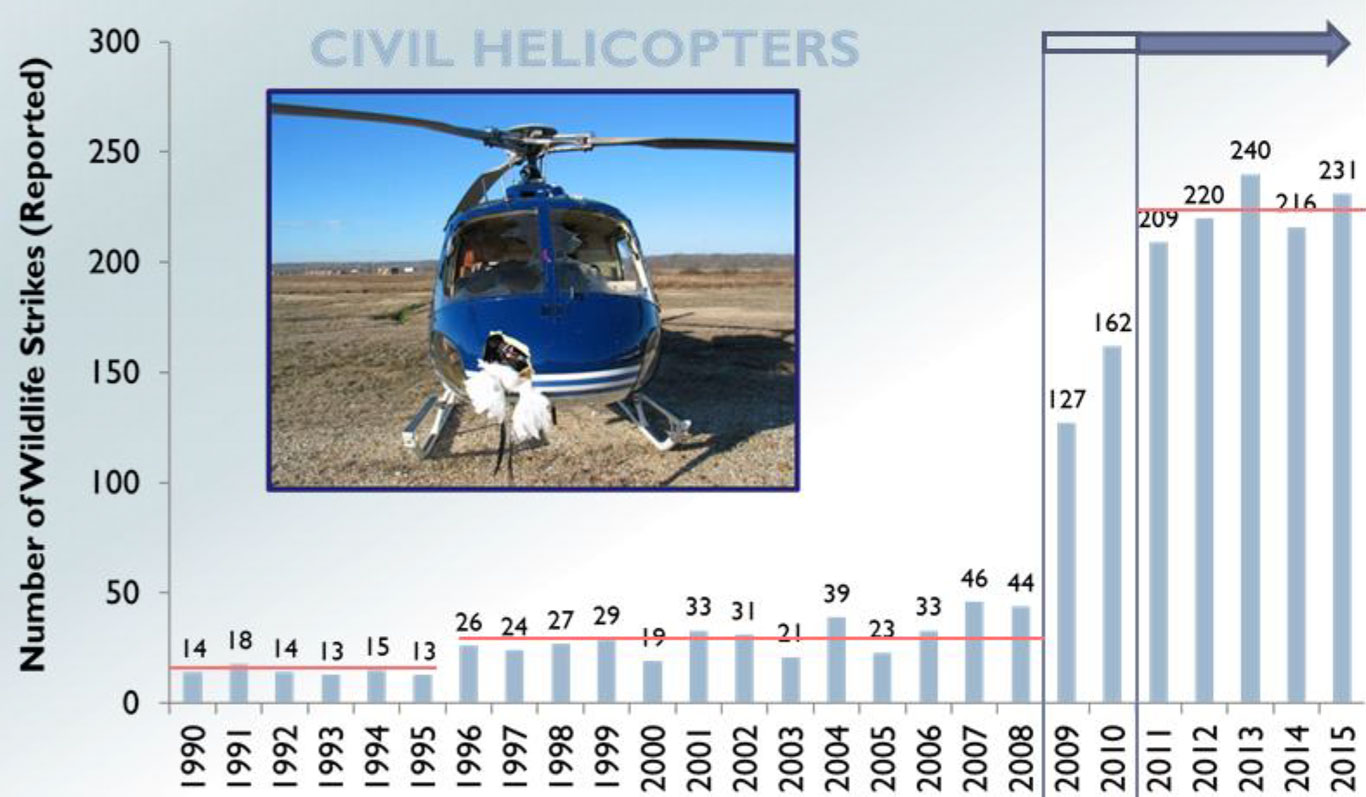
Sadly, a survey of 16 US helicopter operators nationwide, including tour operations, powerline, utility and charter, regarding bird strike mitigation and awareness practices, indicated limited awareness of guidance produced by the Rotorcraft Bird Strike Working Group (RBSWG), of associated ARAC guidance, and National Transportation Safety Board (NTSB) Safety Recommendations. Most operators reported being unaware of, or only vaguely familiar with, the working group and recommendations, and any formal dissemination of this information within organizations was inconsistent.
The survey highlighted several key factors:
1. Bird strike data collection and reporting practices varied widely.
- Only a minority of operators had formal reporting procedures, typically integrated into an existing safety management system (SMS), with events documented using standardised reporting forms.
- Most operators indicated that reporting was informal, relying on verbal notifications, institutional knowledge, or air traffic control notification rather than structured data collection.
2. Helicopter speed is an important aspect in the likelihood and severity of bird-rotorcraft collisions.
- The speed that the helicopter approaches the bird reduces the time required for the bird to assess the threat and initiate evasive flight manoeuvres to avoid the aircraft.
- Rotary operators have found that strikes with some bird species can be reduced when limiting flight speeds to 80 knots. According to the US National Wildlife Strike Database (NWSD) more than ¾ (77.1%) of reported bird strikes on Part 27 rotorcraft (maximum take-off weight less than 3175 kg and having up to 9 passenger seats) where the impact speed was recorded in the NWSD occurred above 80 knots.
3. Increased altitudes
Dolbeer (2006) found that 93% of bird strikes occur below 3,500 ft AGL. Operations during spring and fall migration periods at altitudes below 3,500 ft AGL increases the likelihood of a damaging bird strike. This should also be stated in the helicopter flight manual caution to increase awareness of the operator and/or pilot for increased risk of a migratory bird strike.
4. Training requirements are not currently based on locally observed behaviour of the bird population.
- Training and flight planning should include recognition of common birds in the operating areas, enroute, and airport environments plus seasonal migratory times and concentration patterns.
- Certain areas around airports and cities provide a food source and protection for birds and hence increased population density. These areas should be identified and made known to the flight crews for planning (avoidance) routes, altitudes and airspeeds.
5. Recommended protective strategies
- Helmet and visor for flight crew
- Use of taxi and/or landing lights
NTSB OPERATIONS REPORT
Group Chair's Factual Report
January 9, 2026
ROTORCRAFT BIRD STRIKE WORKING GROUP RECOMMENDATIONS
November 10, 2017, Rev. B May 8, 2019